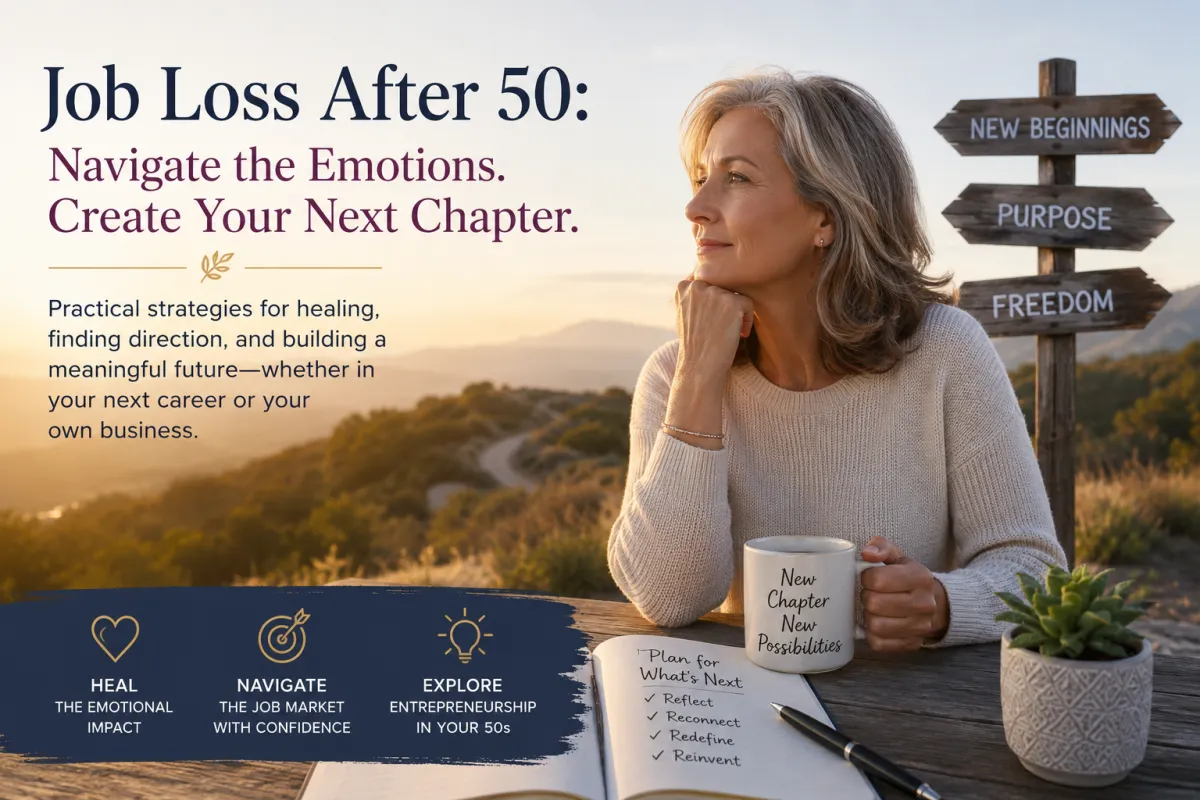
Job Loss After 50: Navigating the Emotional Impact and Finding Your Next Chapter
When a Job Loss Feels Like More Than a Job Loss
Losing a job at any age can be difficult. But for many professionals in their 50s, it often feels like something much bigger than the loss of a paycheck.
By this stage of life, careers have become intertwined with identity. Years of experience, leadership roles, professional accomplishments, and personal sacrifices have helped shape how we see ourselves. When a position unexpectedly ends, it can leave us questioning not only what we do, but who we are.
If you've recently experienced a layoff, restructuring, early retirement, or unexpected career disruption, know this: what you're feeling is normal.
Job loss isn't simply a professional transition. It's an emotional one.
The Hidden Emotional Impact of Job Loss
Many high-achieving professionals move quickly into action mode after losing a job. They update their résumé, activate their network, and begin applying for positions.
But underneath those practical steps are often emotions that go unacknowledged:
Grief for the role, team, and future you expected
Fear about finances and retirement plans
Loss of confidence and professional identity
Shame or embarrassment, even when the job loss wasn't your fault
Anxiety about competing in today's job market
One of the most common experiences I see among women in midlife is the feeling that they've somehow lost their footing. The career path that once felt clear suddenly feels uncertain.
This is where many women begin experiencing what I call Post Success Drift™: the uncomfortable space between a successful past and an undefined future.
The good news is that uncertainty does not mean you're lost. It often means you're standing at the beginning of a new chapter.
Step One: Give Yourself Permission to Process
Before rushing into the next opportunity, allow yourself time to acknowledge what happened.
Ask yourself:
What am I grieving?
What part of this experience feels most difficult?
What do I want to carry forward?
What am I finally ready to leave behind?
Career transitions are not just logistical events. They are identity transitions.
The more honestly you process the emotional side of the experience, the better positioned you'll be to move forward with confidence.
For additional reflection exercises, explore the resources available at Purposeful Pivot's Resources page at www.purposefulpivot.net/resources
Practical Strategies for Navigating the Job Market After 50
While headlines often focus on the challenges of job searching later in life, experienced professionals continue to bring tremendous value to organizations.
Here are several strategies that can help:
Focus on Value, Not Age
Employers hire people who solve problems.
Rather than leading with years of experience, focus on outcomes:
Revenue generated
Teams led
Processes improved
Costs reduced
Customer satisfaction increased
Your experience becomes more compelling when it's translated into business impact.
Activate Your Network
Many opportunities are discovered through conversations rather than online applications.
Reconnect with:
Former colleagues
Industry contacts
Professional associations
Community organizations
LinkedIn connections
Approach networking as relationship-building, not job-seeking.
Refresh Your Personal Brand
Ensure your LinkedIn profile reflects who you are today, not who you were ten years ago.
Your profile should clearly communicate:
Your expertise
The problems you solve
Your unique value proposition
The future you want to create
Stay Open to New Possibilities
Sometimes the next chapter doesn't look like the previous one.
Consulting, fractional leadership, contract work, teaching, coaching, and board service are increasingly attractive options for experienced professionals seeking flexibility and purpose.
Is This the Time to Start a Business?
For some professionals, job loss becomes the catalyst for entrepreneurship.
The question isn't whether you can start a business in your 50s.
The question is whether you have the desire, energy, and commitment to build something new.
Before launching a business, consider:
What expertise do people already seek from me?
What problems can I solve?
Who is my target audience?
How much financial runway do I have?
Do I want a business or a lifestyle practice?
The most successful businesses often begin by leveraging existing expertise and relationships rather than starting from scratch.
Reinvention Is Not Starting Over
One of the biggest misconceptions about career transitions is that they require you to start over.
They don't.
Everything you've learned, accomplished, and experienced comes with you.
The skills that helped you succeed in one chapter can become the foundation for the next.
The goal is not to erase your past.
The goal is to build upon it.
Your Next Chapter Starts Here
If you're navigating job loss, know that this moment does not define your future.
It may feel uncomfortable. It may feel uncertain. But it may also be the opportunity to create a future that aligns more closely with who you are today.
At Purposeful Pivot, I help women move beyond uncertainty, rediscover their identity, and create a meaningful next chapter.
If you're ready to stop drifting and start designing what comes next, explore the resources available at PurposefulPivot.net/resources or learn more about coaching programs at PurposefulPivot.net.
Sometimes the end of one chapter is simply the beginning of a better one.